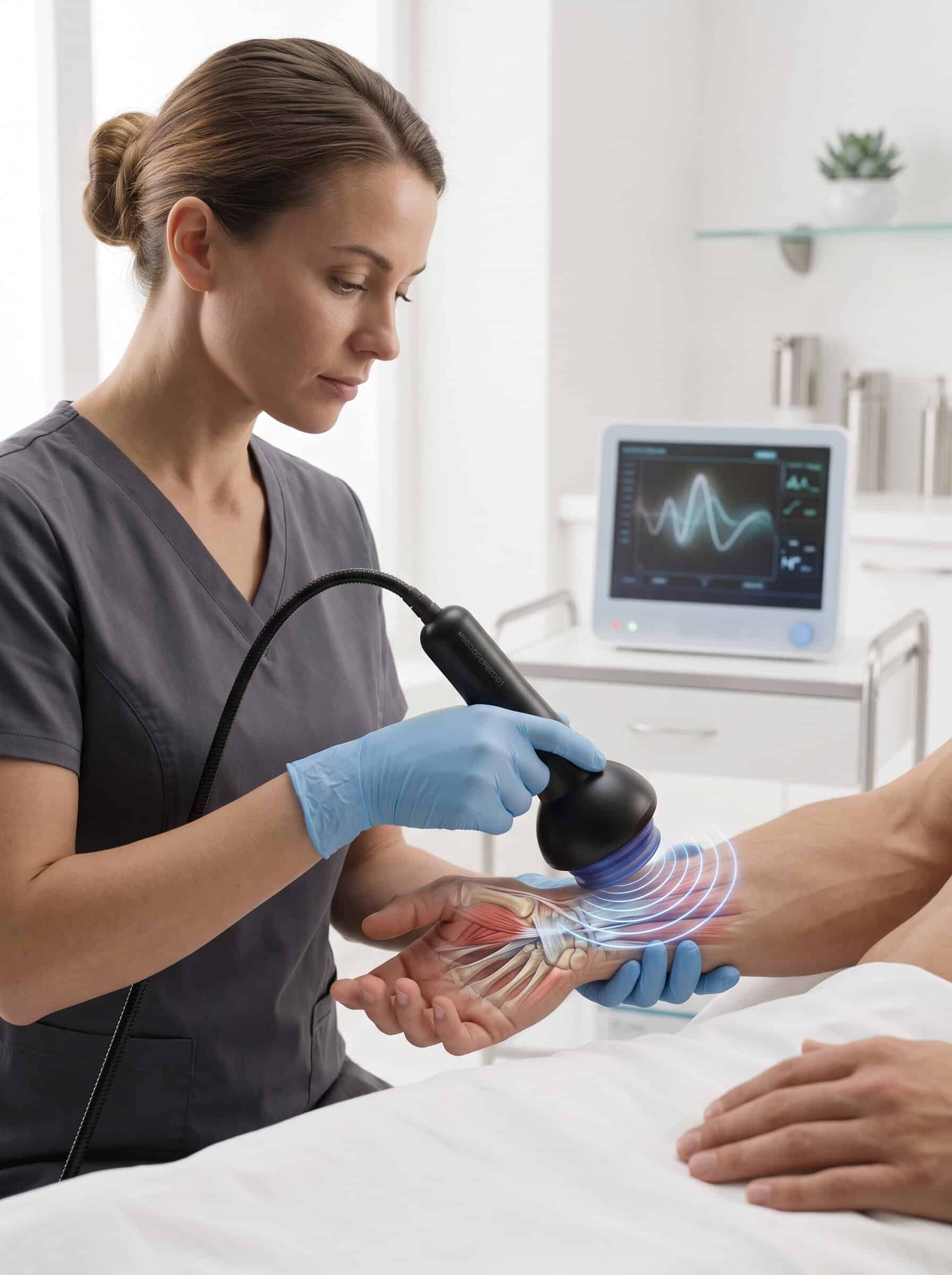


Search for a professional acoustic wave therapy machine and one of the first results is likely to be a consumer gadget selling for a couple hundred dollars, labeled “professional,” shipping from overseas. Search the same thing on a marketplace and you will find dozens more, most of them closer to a massage gun than to anything a clinic would treat a patient with.
That is the problem this article exists to solve. The word “professional” is marketing, not a specification, and anyone can print it on a box. For a practice owner deciding what to put in front of patients, the real question is what actually separates a clinical-grade device from a consumer one, and whether the price gap between them buys anything that matters. It does, and here is exactly what.
A language note first. Buyers shop for this using the word “shockwave,” so that is the language used here where it reflects how the market talks. The clinical category is acoustic wave therapy, and the two refer to the same family of technology. The glossary maps the rest of the naming.
Key Takeaways
- “Professional” on a listing means nothing by itself. Consumer units are routinely labeled professional and medical-grade with no specification to back it up.
- Many cheap “shockwave” devices are not shockwave devices at all. A large share are percussion massagers, closer to a massage gun than to true acoustic wave technology.
- The real dividing lines are output, consistency, build, regulation, and support. Not the label. Not the price tag alone.
- Consistent, controllable energy is the core difference. A clinical device delivers the same output session after session. A consumer unit often cannot, and drifts as it wears.
- The price gap is those differences priced in, not a markup. Engineering, quality control, regulatory compliance, durability, and support cost money.
- The two are built for different jobs. Consumer units are personal-wellness gadgets. Treating patients and putting your reputation behind the result is a different standard.
Why “Professional” On The Box Means Nothing
There is no gate on the word. A factory can stamp “professional,” “medical-grade,” or “clinical” on a $200 unit and list it next to devices that cost fifty times more, and search engines and marketplaces will happily show them side by side. The result is that a practice owner doing early research sees a price range so wide it looks like the expensive options must be overpriced.
They are not comparing the same thing. The label tells you nothing. What follows are the specifications and realities that actually do.
The Real Dividing Lines
True Acoustic Wave Generation Versus Percussion
This is the biggest one, and the one most buyers miss. A genuine acoustic wave device generates a controlled pressure wave that travels into tissue, through one of several established methods such as electrohydraulic, electromagnetic, piezoelectric, or pneumatic generation. Many inexpensive units marketed as “shockwave” do no such thing. They are percussion devices that vibrate against the surface, mechanically closer to a massage gun than to the modality a clinic intends to offer.
If a device cannot tell you how it generates its wave, that is the answer. See how focused acoustic wave therapy devices work, how acoustic wave energy is generated, and the glossary. For the focused versus radial split inside the clinical category, see radial vs focused acoustic wave devices.
Energy Output, Consistency, And Control
A clinical device produces a defined, adjustable energy output and holds it steady, pulse after pulse, session after session. That consistency is what lets a provider work to a repeatable approach and adjust deliberately for the patient in front of them. Consumer units typically offer a narrow, imprecise range, cannot hold output steady under sustained use, and drift as components wear. For a one-off personal gadget that is tolerable. For a service a practice stands behind, inconsistent energy is the problem.
Build Quality And Durability
A professional device is engineered to run many sessions a day for years, with components rated for that duty cycle and output that stays consistent across the life of the handpiece. Consumer units are not built for clinical throughput. They wear faster, their output degrades sooner, and when they fail there is rarely a serviceable path back. How to Choose the Best Focused Wave Therapy Machine covers how to weigh durability and total cost of ownership rather than sticker price.
Regulatory Status And Safety
Clinical-grade devices are manufactured and listed under medical-device regulation, with the quality-control and safety standards that come with it. The mechanical energy involved is real, which is exactly why controlled delivery and proper safety design matter. See how focused acoustic wave devices deliver mechanical energy safely. A cheap import of unverifiable origin gives you no assurance on any of that, and putting an uncertified device of unknown output in front of a patient is a liability question before it is a clinical one.
Support, Training, And Accountability
When a clinical device has an issue, there is a manufacturer behind it: service, parts, training, and someone accountable for the outcome. When a $200 marketplace unit fails, the seller is often a storefront that may not exist next quarter. For a practice, that difference is not a convenience. It is whether the service you are building rests on something you can rely on.
Why The Price Gap Exists
Set the two side by side and the gap looks enormous, a few hundred dollars against the tens of thousands a professional system runs. The instinct is to suspect a markup. The reality is that the gap is the five differences above, priced in.
Precision engineering to generate and control a true acoustic wave costs money. So does the quality control that keeps output consistent, the durable components rated for clinical use, the regulatory compliance and testing, and the service and training infrastructure behind the device. A consumer unit is cheap because it skips all of it. You are not paying more for the same thing. You are paying for a different thing, built to a standard the cheap one was never trying to meet. Public cost ranges by type sit in the Longest Medical cost guide.
Which One Is Actually For You
Consumer devices are not a scam across the board. For an individual managing everyday aches at home, a well-reviewed personal unit may be a reasonable purchase, provided the buyer understands it is a wellness gadget, not clinical equipment, and may be a percussion device rather than true acoustic wave at all.
The calculation changes completely the moment you are treating patients. Then you are accountable for consistent delivery, for safety, for a repeatable standard, and for your professional reputation. That is a clinical-grade decision, and a consumer unit is the wrong tool for it regardless of how much it saves up front. A device that cannot hold its output or stand behind its results does not build a service. It undermines one.
Frequently Asked Questions
Can I Just Buy My Own Shockwave Therapy Machine?
You can buy a device easily, but for clinical use the real questions are whether it is genuine acoustic wave technology, whether it is properly regulated, and whether whoever operates it is within their scope of practice. Price is the least of it.
Do The Cheap Shockwave Machines Really Work?
Many are percussion massagers rather than true acoustic wave devices, so “work” depends on what you expected. For clinical results in a practice setting, consumer-grade units do not deliver the consistent, controlled output the modality depends on.
Can You Do Shockwave Therapy At Home?
Consumer units exist for personal use, but they are wellness gadgets, not clinical equipment. Anyone considering it for a specific issue should speak with a provider first.
How Can I Tell If A Device Is Genuinely Professional-Grade?
Ask how it generates its wave, what its energy output and range are, what its regulatory listing is, and what service and training come with it. A genuine clinical device answers all four plainly. A relabeled consumer unit usually cannot answer any.
Why Are Some Machines So Much Cheaper Than Others?
Because they skip the engineering, quality control, regulatory compliance, durability, and support that a clinical device is built around. The price gap reflects a difference in what the device actually is, not a markup.
Choosing On The Right Standard
For a practice, this is not really a price decision. It is a decision about whether the device can hold a consistent standard, meet safety and regulatory expectations, and come with someone accountable behind it. That is the line between a gadget and clinical equipment.
OmniWave builds professional-grade focused electrohydraulic acoustic wave systems, engineered and manufactured in the USA, and treats the device as the start of a partnership rather than the end of a sale. That includes the training, support, and practice program a marketplace listing will never include.
If you are still on the buying criteria, start with How to Choose the Best Focused Wave Therapy Machine for Your Practice. When you want the standard mapped to your practice, Book A Call.

