
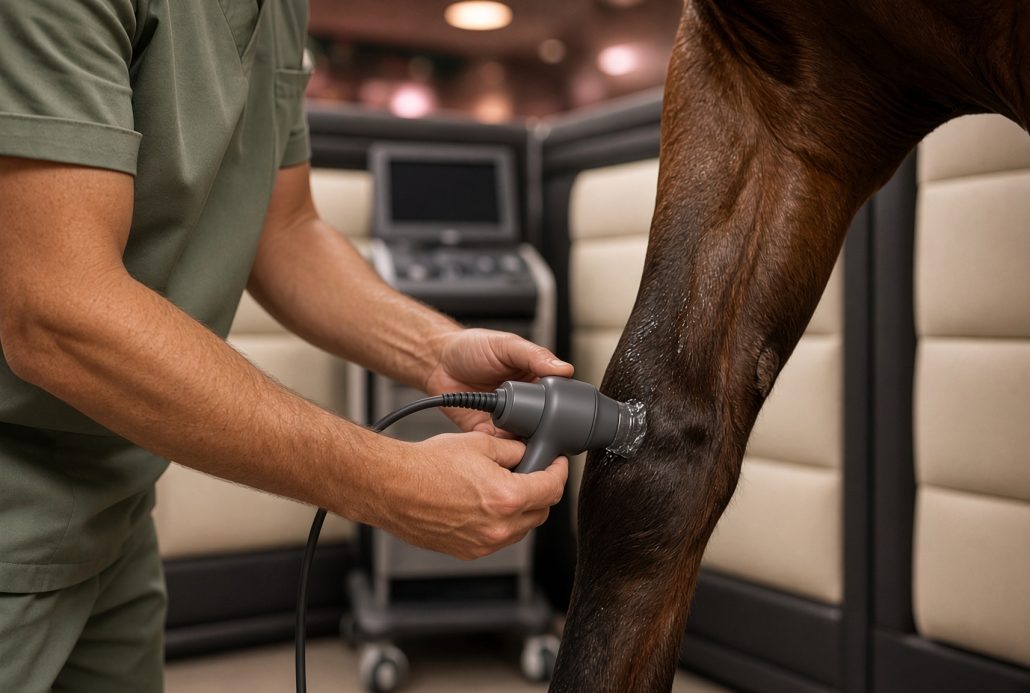
Horses have been treated with acoustic wave therapy for decades. Dogs came later. Owners hear a familiar pitch: noninvasive, drug-free, a handful of short sessions that sit between medication and surgery.
This piece is a read of the published record, species by species. Strong evidence gets called strong. Thin or mixed evidence gets called that too.
One naming note before the studies. OmniWave and this article use acoustic wave therapy. The veterinary papers linked below use a different clinical name for the same pressure-wave technology. Source titles will not always match the language in the body.
Key Takeaways
- Horses have the deepest track record. The American Association of Equine Practitioners recognizes evidence-based use for chronic soft-tissue and joint problems, including suspensory ligament desmitis, tendon injuries, and osteoarthritis.
- Dogs are next, with a smaller and less consistent base. Most of the work sits in osteoarthritis of the elbow, hip, and stifle, plus shoulder tendon injuries. The signal looks better as an adjunct than as a last pass on end-stage joints.
- Cats have almost no published evidence. A four-decade literature review found no qualifying feline studies.
- The proposed mechanism is mechanotransduction. Acoustic pressure waves prompt cells to release growth factors and signaling molecules that support new blood vessel formation, quieter inflammation, and tissue remodeling.
- Tolerance is generally good when a veterinarian runs the session. Side effects are usually mild and short-lived. Clear contraindications exist. This is not a home device.
- Protocols are still maturing. Reviews in both species keep asking for larger, better-controlled trials before dosing is treated as settled.
How Acoustic Pressure Waves Reach Animal Tissue
A handpiece sends acoustic pressure waves into a targeted area of tissue. The intended effect is mechanical, not thermal. As the waves move through tissue they create small stresses. Cells convert those stresses into biological signals.
That conversion is mechanotransduction. The signals release growth factors and anti-inflammatory compounds, encourage new vessels, and support remodeling in bone and soft tissue. The 2023 review in the Equine Veterinary Journal and a detailed equine review indexed on PMC both walk through this pathway.
Energy arrives in two patterns. Focused waves converge at a point at depth. Radial pressure waves spread across a broader, shallower field. Veterinary clinics most often use electrohydraulic or piezoelectric generators.
Electromagnetic systems show up as well. The same split is the buying fork on the human-practice side. See radial versus focused delivery and the mechanism guide if you want the device-level version of this, or the glossary if the naming is what is slowing you down.
The Equine Record Is The Deepest
Horses are where the research runs longest. The AAEP position statement, approved in 2025, lists evidence-based indications for chronic soft-tissue and joint conditions: suspensory ligament desmitis, tendon injuries, and osteoarthritis.
For those uses the statement points to clinical studies and meta-analyses showing reduced pain and improved function. It also flags emerging uses with less proof, including myofascial pain, wound healing, and tissue regeneration, and treats those as early rather than settled.
Practice use is wider than that evidence-based list. Reviews of the equine literature describe osteoarthritis, thoracolumbar back pain, navicular syndrome, tendinopathy, and proximal suspensory desmopathy. A typical clinical protocol in the equine review on PMC uses a portable device on the site for about three to four minutes, commonly across three sessions spaced about three weeks apart, usually with light sedation so the horse stays still.
The honest limit is standardization. Reviewers note that energy levels, pulse counts, and treatment intervals differ from study to study. Specific evidence-based dosing recommendations are still largely anecdotal. The direction of the evidence is positive, especially for ligament and tendon injuries. The precision is not there yet.
Canine Evidence Is Real And Thinner
Canine use is growing, mostly as an adjunct for osteoarthritis of the elbow, hip, and stifle, and for shoulder tendon problems. Peer-reviewed work includes controlled studies on elbow and hip osteoarthritis and a case series treating supraspinatus and biceps tendinopathies.
A 2023 paper in Frontiers in Veterinary Science describes a newer applicator that let dogs be treated awake, without sedation. That removes a real practical barrier.
The evidence needs a straight read. A 2026 randomized, double-blinded trial in dogs with advanced, treatment-resistant elbow and stifle osteoarthritis found only modest and inconsistent improvement. Benefit was limited in that end-stage group.
The treatment was well tolerated, with no major adverse events. A broader systematic review of the modality in sport and companion animals graded the certainty of evidence for canine osteoarthritis as low. That grade rested on one underpowered controlled trial and a couple of observational reports with a high risk of bias.
Put those together and the defensible position is narrow. Acoustic wave therapy is a reasonable adjunct in dogs, more encouraging earlier in the disease and inside a broader plan that includes medication, weight management, and rehabilitation.
Veterinary clinical commentary in the IVC Journal reports outcomes that rival anti-inflammatory drugs without long-term drug exposure, and it names the trade-offs: cost, sedation, and variable response. It is not a standalone cure. The canine research base is still catching up to the equine one.
Cats Have No Published Evidence Base
This section stays short because the literature does. The systematic review that scanned four decades of papers found no qualifying feline studies. Acoustic wave therapy in cats is not evidence-based today. Any use rests on extrapolation from other species and a veterinarian’s clinical judgment, not on published feline data.
Safety, Side Effects, And Contraindications
The AAEP describes the modality as generally safe when a licensed veterinarian administers it. Reported side effects are usually mild and short-lived: brief discomfort during treatment, and mild reddening or bruising of the skin. Serious complications are rare.
The statement also lists clear contraindications. Acoustic wave therapy should be avoided over malignant tumors in the treatment area, in animals with bleeding disorders or on anticoagulant therapy, in pregnant mares, and over the growth plates of young animals.
One welfare point shapes how the treatment is regulated. The modality has a pain-relieving effect, and that analgesia can mask an underlying injury. If an animal returns to hard work too soon, the masked pain raises the risk of reinjury.
The AAEP recommends a minimum 72-hour withdrawal before competition, and many racing and show jurisdictions set their own rules around use near events. Pain relief and healing are not the same thing.
What The Field Still Has Not Settled
The evidence is strongest and most established in horses, particularly for chronic tendon and ligament injuries and osteoarthritis. In dogs it is a credible adjunct with real but thinner support, best used inside a broader treatment plan and with realistic expectations about how far it will move function. In cats there is no evidence base to stand on.
Across every species the open question is the same: standardization. Energy settings, session counts, and spacing still vary widely between studies. That is exactly what the reviews keep flagging. Better-designed trials will tell the field how much of the early promise holds, and for which patients.
Frequently Asked Questions
Is Acoustic Wave Therapy The Same As Therapeutic Ultrasound?
No. Therapeutic ultrasound delivers continuous sound energy, often to warm tissue. Acoustic wave therapy delivers discrete, higher-energy pressure waves aimed at a specific site. The mechanism and the equipment are different. For the human-device version of that distinction, see how focused acoustic wave devices deliver mechanical energy.
How Many Sessions Does An Animal Usually Need?
Protocols vary. A common equine course is around three sessions spaced roughly three weeks apart. The veterinarian sets the plan based on the tissue involved, the severity, and how the animal responds. That variability is a research gap, not a hidden protocol.
Does The Treatment Hurt?
Most animals tolerate it. Horses are often given light sedation so they stay still. Reported side effects are usually limited to brief discomfort and mild skin reactions.
Which Animals Should Not Receive It?
Per the AAEP, it should be avoided over tumors in the treatment area, in patients with bleeding disorders or on blood thinners, in pregnant mares, and over the growth plates of young animals.
Can I Use A Human Acoustic Wave Device On My Pet Or Horse?
No. Acoustic wave therapy for animals should be delivered by a licensed veterinarian using appropriate equipment and settings. A human clinic device is not a barn or living-room workaround. Speak with your veterinarian before considering it.
OmniWave builds focused acoustic wave technology for human clinical practice. Veterinary use sits outside our current scope. This article is an educational overview of a field we follow because the mechanism is the same one human practices evaluate when they buy a machine. Nothing here is veterinary medical advice. OmniWave devices are intended for human use. If you are weighing acoustic wave therapy for an animal, the next step is a licensed veterinarian, not a sales call.
If you run a human practice and you read this for the evidence standard or the focused-versus-radial split, start with How to Choose the Best Focused Wave Therapy Machine for Your Practice. When you want the buying conversation rather than the literature, Book A Call.